Building the Infrastructure Behind the World's Largest Drone Network

Spexi Geospatial is building an aerial data archive of standardized drone imagery at scale. The model depends on solving two problems simultaneously: supply (enough pilots flying enough missions to make the archive valuable) and demand (enough customers buying that data to make the business sustainable).
In 2024, Spexi's COO reached out to me regarding their community and token plans. The latter provided a potential way to compensate pilots in any conceivable country, which would be a boon to the company’s supply challenges.
In 2025, I joined Spexi to grow their pilot community and to help the company navigate their token strategy without compromising that community. Spexi needed thousands of independent drone operators throughout the world to fly standardized missions, upload consistently, and keep coming back. The mechanism designed to solve that was LayerDrone: a network protocol and non-profit entity that would steward pilot activity and, critically, fund pilot incentives through a planned token launch.
By 2026, the network and its community of pilot contributors had grown substantially. The network had moved to mainnet. Pilots were now paid by LayerDrone via a token — but not the token I was hired to help launch.

The Challenge: Grow the Pilot Community While Navigating Crypto
LayerDrone’s planned token still hadn’t launched a year-and-a-half after I joined Spexi. Regulatory headwinds, market conditions, and the risk-to-reward ratio made it untenable.
This wasn't surprising: my initial recommendation was to avoid a token (for all these reasons and more) and to pursue a stablecoin model if crypto had to be part of the equation. Since that initial conversation in 2024, those token conditions had only worsened. Meanwhile, USDC (a token with the same value as the US-dollar) had been successfully introduced as a pilot reward — capturing almost all the benefits of a token for pilots without any of the volatile risks I was worried about.
Spexi’s underlying network moved to mainnet. The network’s contributor reward infrastructure was upgraded. Major enterprise customers like Niantic Spatial and Esri are now powered by Spexi and the LayerDrone network. The network’s community has never been larger or more engaged. Under these circumstances, I wouldn’t recommend launching LayerDrone's token even if my job depended on it.
Here’s how I helped Spexi grow their community, establish a new network protocol, and navigate an open-ended token launch…
My Role: Grow Community Around a Network Protocol
Launching the world’s largest autonomous aerial network: LayerDrone. Within 60 days of joining Spexi, I helped launch LayerDrone’s website, white paper, and founding community. This included establishing LayerDrone as a legal entity and a network protocol. I was the point of contact for all of LayerDrone’s agencies and operational partners, and I defined LayerDrone’s founding brand (though our agency defined its visual identity). A little more than a year after I was hired, we took the LayerDrone network to mainnet.
Founding and scaling the community to tens of thousands of contributors. I built LayerDrone's community from zero to tens of thousands of contributors, launching the brand’s social channels and establishing 50,000+ followers. Merging with the Spexi Discord, I grew that platform from 3,200 members to over 12,000 via a weekly operational cadence of community calls, leaderboards, contributor spotlights, and more. The pilot community became a stronger support channel, a better feedback layer for the network, and a marketing flywheel for content and communications. When pilots had questions about new hardware, payment mechanics, or upcoming missions, the community infrastructure is where those questions got answered.
XP system design and deprecation. I created LayerDrone's Experience Points (XP) system: a contribution framework for the network through content creation, support, and community participation. XP presented a way to contribute to the network without flying a drone. Within a year, the system had 40,000+ registered users and 122,000+ completed tasks. When the network strategy matured and the rationale for the system changed, I managed a careful deprecation that preserved the dataset, maintained contributor trust, and avoided community backlash. If LayerDrone does launch a token and XP is considered for how it’s distributed, I have left them everything they need to incorporate it without issue.
USDC launch. The March 2026 USDC launch was the most operationally sensitive moment of my time at Spexi. Before then, pilots were paid every two weeks via Stripe and their local currency. It’s a system relatively familiar to anyone who’s had to work most any job. Switching to USDC presented a significant potential obstacle to pilots. Would the network lose a substantial number of contributors via the change? Would pilots understand how to use USDC? Answers required regular community feedback. Shifting to USDC required a communications strategy that was honest about what had changed, clear about what pilots were now earning, and capable enough to prevent churn. It also needed to navigate legal complexities as the underlying product's terms and conditions updated simultaneously. I led that strategy. The launch exceeded expectations with no measurable loss in contributors, and an increase in mission campaign completion speed.
Launching North America’s largest-ever drone campaign. I helped Spexi launch the largest single expansion in network history: 200,000+ missions across 40+ southern US cities, using Reputation Points (RP) rewards to test incentive mechanics at scale. The campaign proved how non-cash incentives can (can cannot) drive real operational growth. This was a direct input into the eventual USDC model.
Partnerships with the creators of Pokémon GO, Esri, and other enterprises. Esri is the dominant platform in professional GIS. Niantic Spatial is building the spatial computing layer for consumer applications. Both now work with Spexi, with their work powered by the LayerDrone network. I supported the communications and positioning work around these announcements, interfacing with PR teams while helping frame Spexi's value proposition for enterprise audiences and the pilot community that built the network.



The Drone Network podcast (now in the top 1% of drone podcasts!). I produced and hosted a weekly show covering the drone industry and documenting the network's growth. Guests have included figures from across the commercial drone and geospatial sectors, like YouTube’s most popular drone expert, and the CEO building the USA’s first domestic drone. The podcast functions as a content flywheel: educating pilots, attracting ecosystem partners, and extending Spexi's reach beyond its existing community.
LayerDrone’s documentation and content. Did LayerDrone do or say something before mid-2026? It was probably me. (Unless it was someone else.)
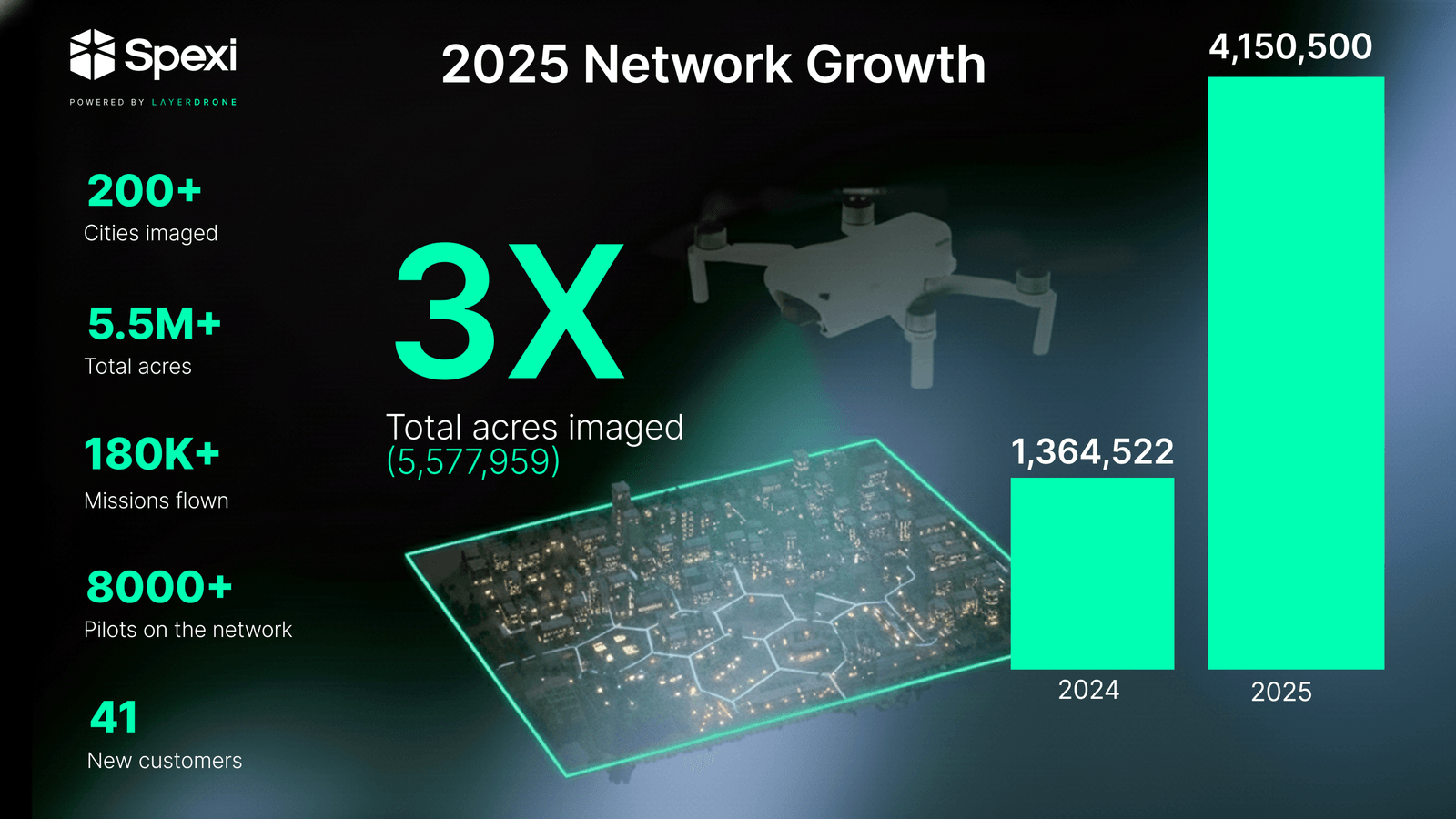
Results: 10x contributor growth, a 307% YoY increase in network coverage, multiple partners
I helped establish network proof and scale:
- 6.66 million acres imaged across 228,000+ successful missions and 11,000 registered pilots on the network
- Enterprise partnerships with Esri and Niantic Spatial
- USDC on Base mainnet: real pilot earnings, first-of-kind payment infrastructure for aerial data networks
I helped create and scale the pilot contributor community:
- Discord: 3,000 → 12,000+ members
- Social: 0 → 50,000+ followers
- 40,000+ XP holders; 122,000+ quests completed; 3m+ XP rewarded
- Co-hosted weekly community call cadence maintained throughout; I introduced monthly community campaigns and weekly community polls, reports, and leaderboards.
I lead multiple major campaigns and launches:
- Open Capture Campaign: 200,000+ missions, largest single expansion in network history
- DJI Mini 2 deprecation completed without significant community disruption
- USDC launch completed without significant community disruption, and with notable benefits
- Mainnet launch completed without technical or legal issues
- Token optionality maintained regardless of strategy
What's Next: Infrastructure Powering Spatially Aware AI
LayerDrone is now infrastructure. It pays pilots, it maintains standards, and it operates quietly in the background while Spexi focuses on what comes next: converting that supply into enterprise demand, deepening partnerships with Esri and Niantic, and turning a proven aerial data archive into a scalable commercial business.
The community, the payment infrastructure, and the operational systems built over 18 months are what made that possible. During my first year with the team, pilot contributors 10x'd while network coverage expanded by 307% YoY. Spexi now has 11,000 pilots who can fly for the network, a data archive growing past 6.66 million acres, and enterprise partners who have validated the model at the highest level.
That's the foundation. Where Spexi takes it is now up to them.